Beyond the Prototype: Designing Dual-Branded Hotels That Perform
We believe dual-branded hotels are most successful when they are designed around behavior, not just brand standards. At Hyatt Place / Hyatt House Indianapolis, our Prototypical Studio approached the project through the lens of two distinct guest journeys: the Hyatt Place guest, often arriving for a shorter, more transient stay, and the Hyatt House guest, looking for the comfort and function of an extended-stay experience. The opportunity was to create a property that felt cohesive from the moment of arrival, while still allowing each brand to deliver on its promise where it mattered most.
That is the promise—and the challenge—of dual-branded hospitality. By combining two flags under one roof, these properties can broaden market appeal, optimize operations, and unlock stronger returns. But behind that efficiency lies a complex design question: how do you create one property that supports two different brands, two different guest behaviors, and one shared operating model?
This is where prototypical design becomes essential.
Designing Within—and Between—Brand Standards
Prototypical design is rooted in brand standards. It provides a framework for consistency, efficiency, and scalability across portfolios. But in a dual-branded property, that framework doubles in complexity. Designers must navigate two sets of guidelines, two guest profiles, and often two operational models—all within a shared footprint.
The role of our Prototypical Studio is to bridge that gap. The work is not about choosing one brand over the other, but about interpreting both in a way that feels intentional to the guest, efficient for the operator, and commercially sound for the owner. It requires a deep understanding of where standards must be upheld, where flexibility exists, and where targeted customization can create value.
This is where a “prototype plus” approach becomes critical. Prototype plus is where brand consistency meets project-specific value. It respects the standards that make a prototype efficient, then layers in the right amount of customization to support the market, the guest, and the owner’s goals.
Shared Spaces: Creating Cohesion Through Story
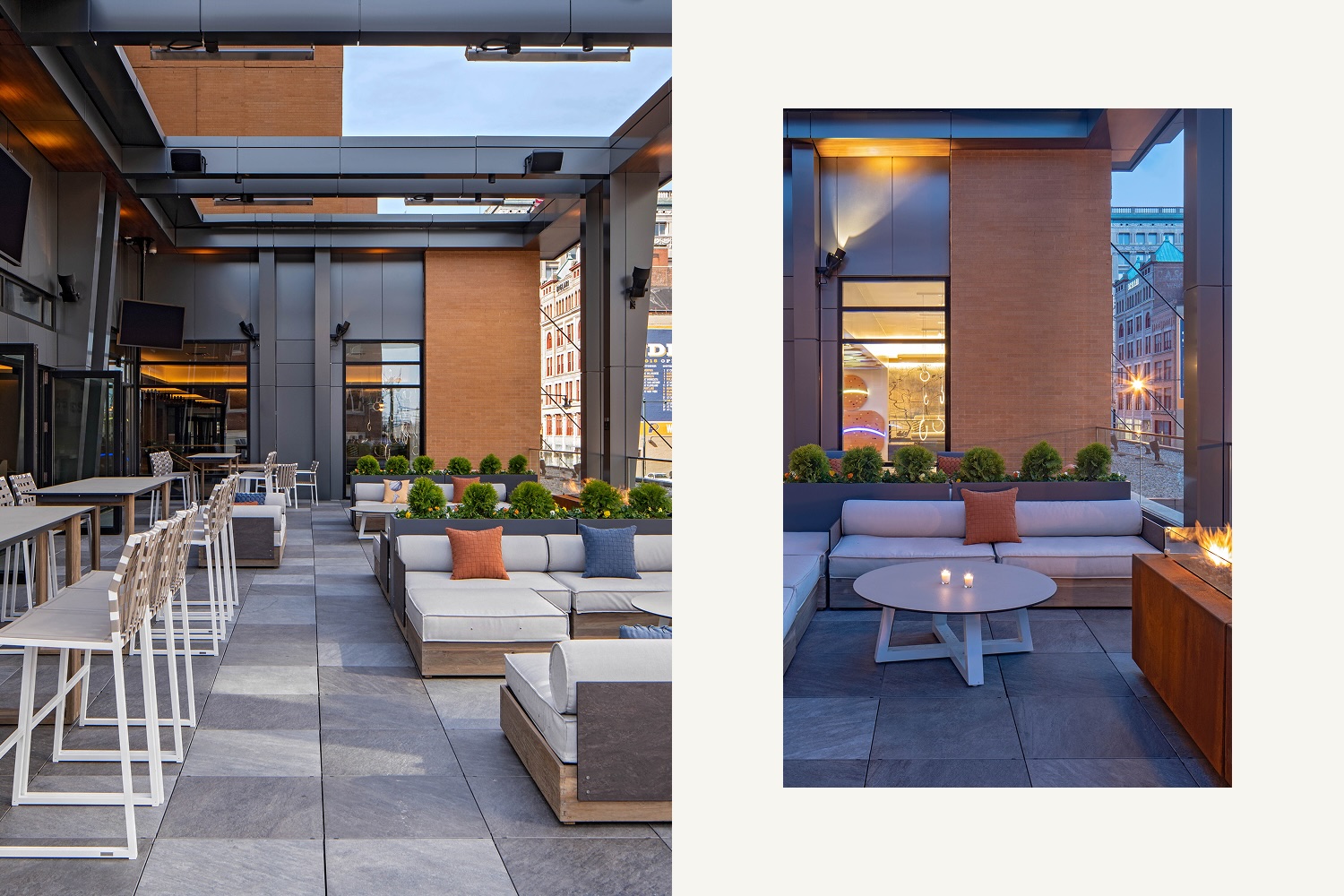
Public spaces are where dual-branded properties either succeed or fall apart. Lobbies, bars, breakfast areas, and social spaces are often shared, meaning they must serve multiple guest types while still aligning with both brands.
For Hyatt Place, the public space needs to support quick transitions: arrival, breakfast, work, meetups, and evening social energy. For Hyatt House, it also has to support routine: a place to gather, recharge, and feel anchored during a longer stay. The shared environment has to do both without feeling over-programmed.
This is where local storytelling becomes more than a design layer. It becomes the connective tissue.
While brand standards provide structure, local context provides meaning. In a dual-branded property, that narrative can help two brands coexist without feeling disjointed. The most effective approach is to create a unifying design language—one that sits comfortably within both brand frameworks—then layer in moments of identity through materiality, art, graphics, lighting, and spatial zoning.
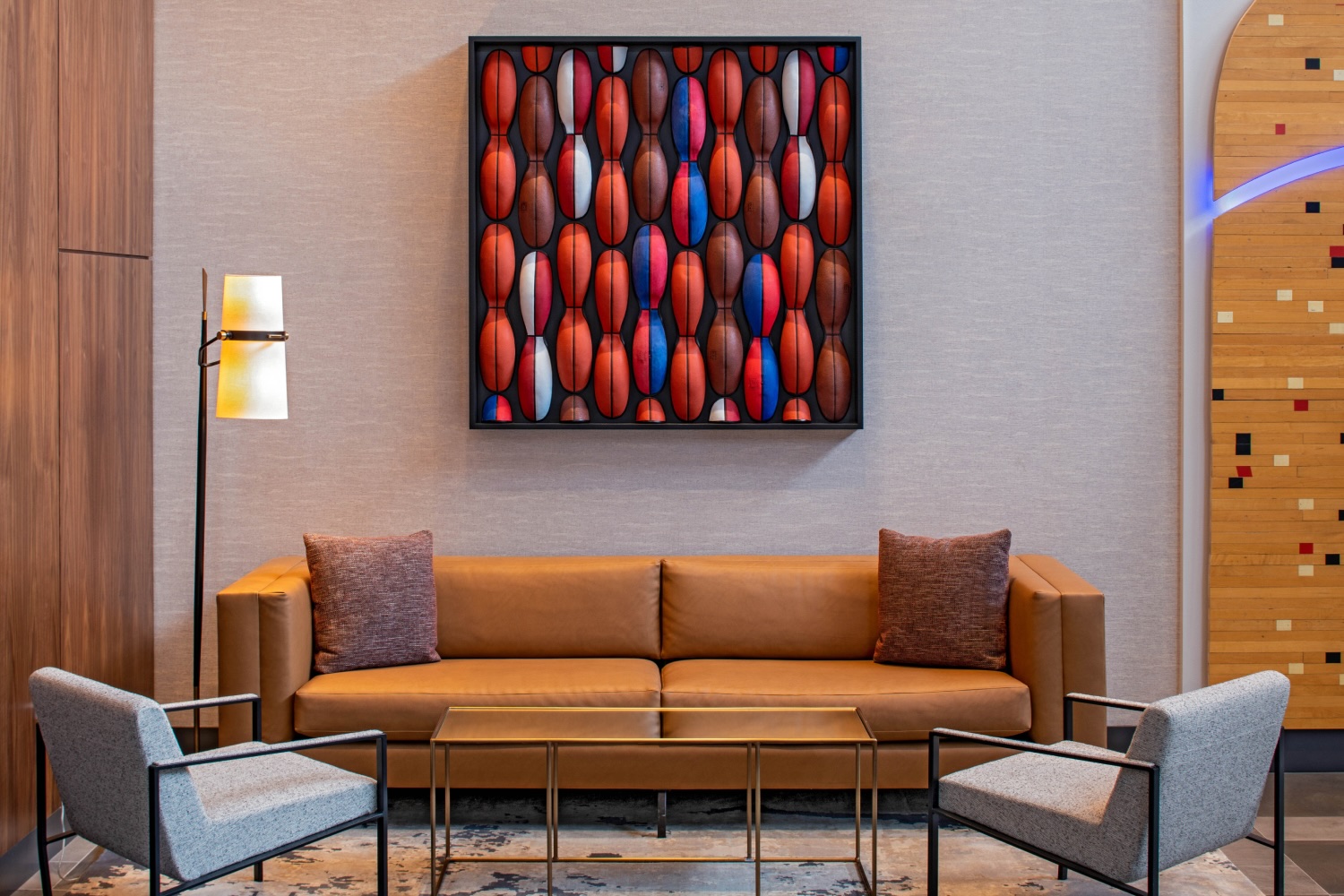
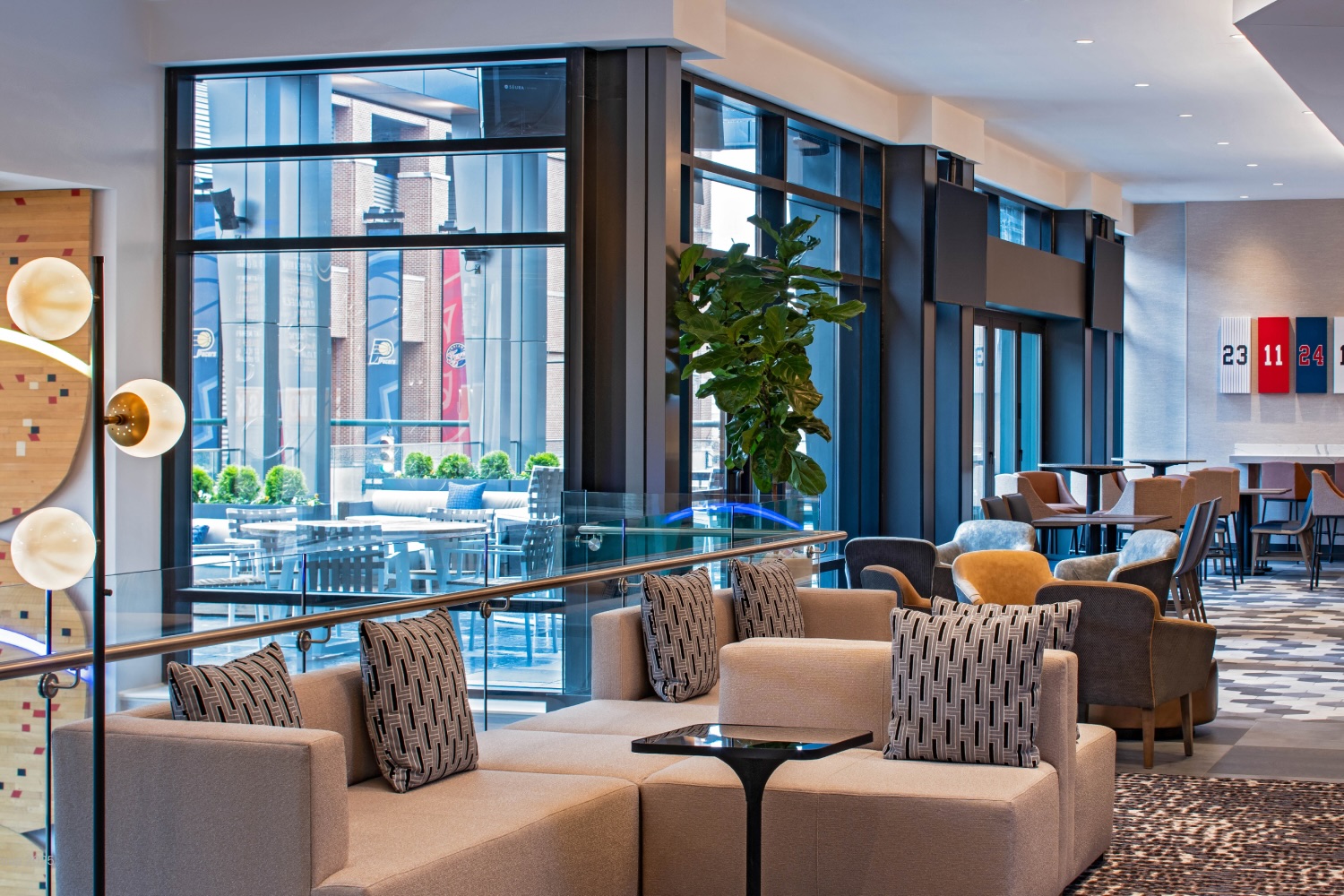
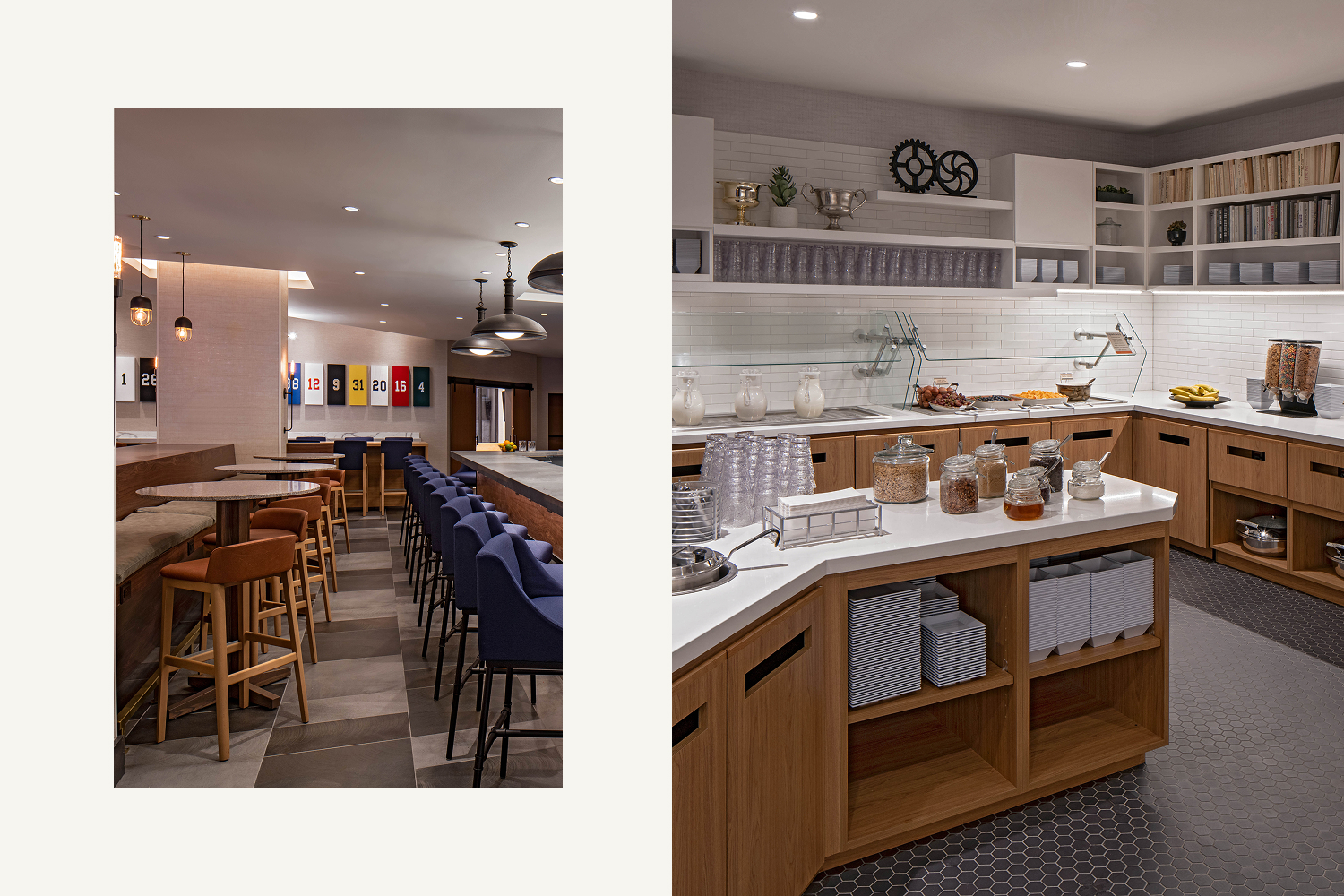
At Hyatt Place / Hyatt House Indianapolis, that connective tissue came from the city’s identity as a sports capital—a place shaped by competition, movement, fandom, and civic pride. The public realm is designed as a dynamic, shared hub, using bold installations and layered graphics to create energy and connection. A suspended art piece made from reclaimed gymnasium flooring anchors the arrival experience, while integrated LED elements shift to reflect local teams.
Rather than splitting the space into two identities, the design leans into a single, locally inspired story—one that both brands can inhabit. Sports references carry through the property in different ways: more energetic and immersive in the public areas, more subdued and abstract in the guestrooms. The result is cohesive, engaging, and unmistakably tied to place.
Guestrooms: Differentiation Where It Matters Most
If public spaces are about cohesion, guestrooms are where distinction becomes critical.
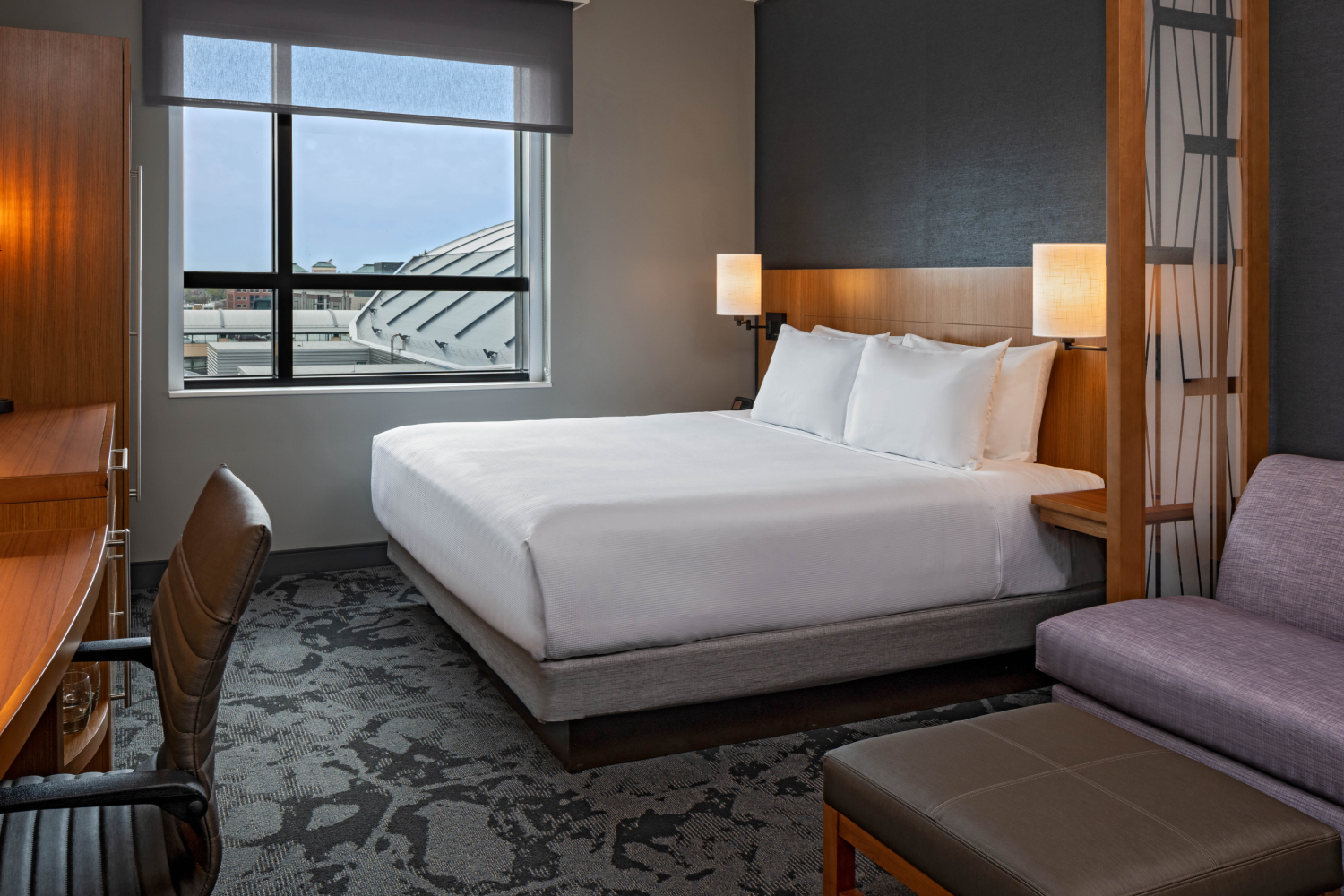
Each brand carries its own expectations. Hyatt Place guestrooms need to support the short-stay traveler with intuitive zones for sleeping, working, and relaxing. Hyatt House guestrooms need to work harder as a temporary residence, with greater emphasis on comfort, storage, kitchen functionality, and the routines of an extended stay.
These differences must be clearly expressed in layout, functionality, and feel, even when the underlying design system is shared.
Prototypical design allows for this balance. Core elements such as millwork, lighting strategies, and material palettes align with brand standards, while layered enhancements—artwork, textures, and spatial planning—introduce nuance. These targeted customizations create distinction where it matters most, reinforcing each brand while maintaining an underlying continuity.
In Indianapolis, this approach is evident in the guestroom experience. Sports references carry through, but in a more subdued and abstract way. Custom prints evoke court patterns and motion without becoming literal. The energy of the public spaces softens into something more personal and restorative.
The two brands remain distinct, but they are clearly part of the same story.
Designing for Operational Reality
Beyond the guest experience, dual-branded properties demand a high level of operational alignment. Shared back-of-house spaces, staffing models, circulation paths, amenity planning, and food and beverage programming all influence how the hotel functions day to day.
In a dual-brand environment, design decisions have operational consequences. A shared lobby can reduce redundancy, but only if circulation is intuitive. A shared food and beverage area can improve efficiency, but only if it is planned around combined guest counts, daypart demand, and the different ways each guest type uses the space.
That is especially critical at breakfast. In a dual-branded hotel, the breakfast program is not simply serving one brand’s guest profile. It must account for the combined occupancy of both hotels, the pace of short-stay travelers moving quickly through the morning, and the routines of extended-stay guests who may use the space differently over multiple days. Buffet layout, queuing, seating capacity, service flow, and adjacency to other public areas all become essential planning decisions.
The same thinking applies beyond breakfast. Evening social occasions, grab-and-go behavior, lobby work sessions, group arrivals, and informal meetings all place different demands on shared F&B and public spaces. When those moments are considered early, the design can support both operational efficiency and a better guest experience.
Prototypical design plays a key role here. Detailed documentation, standardized specifications, and early coordination with procurement ensure that what is designed can be executed efficiently—and repeated across multiple properties when needed. A unified material palette can streamline procurement, but only if each brand still feels distinct where the guest expects it.
Model rooms and prototype reviews further support this process, allowing teams to test decisions before they scale. In dual-brand environments, this step becomes even more valuable, helping resolve conflicts between standards, streamline implementation, and protect the guest experience from concept through opening.
One Property, Two Experiences—Done Right
Dual-branded hotels offer clear advantages, but they require a careful balance of consistency and differentiation. Without a thoughtful approach, they risk feeling fragmented, diluted, or operationally inefficient.
Prototypical design provides the framework to avoid that outcome. It ensures that brand standards are respected, operations are optimized, and the guest experience remains clear and intentional.
When combined with strong storytelling, smart programming, and a deep understanding of place, it allows two brands to not only coexist—but to enhance one another.
The result is a property that feels unified, efficient, and distinctly memorable.